Does Your Production Line Pass the V-Curve Test?
The LineIQ beta now grades your packaging line against the speed V-curve and your real uptime. It is a beta feature: try it on your own line and tell us what we got wrong.
LineIQ Team6 min read
Machine speeds on a line rarely stay where they were first set. A labeler gets replaced, a case packer gets slowed down for a new format, a filler gets a speed bump after a retrofit. Each change makes sense on its own. Whether the speeds still make sense together is a separate question.
There's a classic rule for that, called the speed V-curve, and the LineIQ beta calculator now grades your line against it. It's a beta feature, and we're opening it to anyone who wants to try it and tell us what's wrong with it.
What the V-curve says
Your filler is often the most expensive and least flexible machine on the line. It should set the pace. Every machine further away from it should run a bit faster:
| Machine | Speed | Vs. filler |
|---|---|---|
| Depalletizer | 400 ppm | +33% |
| Filler/Capper (monobloc) | 300 ppm | sets the pace |
| Labeler | 340 ppm | +13% |
| Case packer | 370 ppm | +23% |
| Palletizer | 400 ppm | +33% |
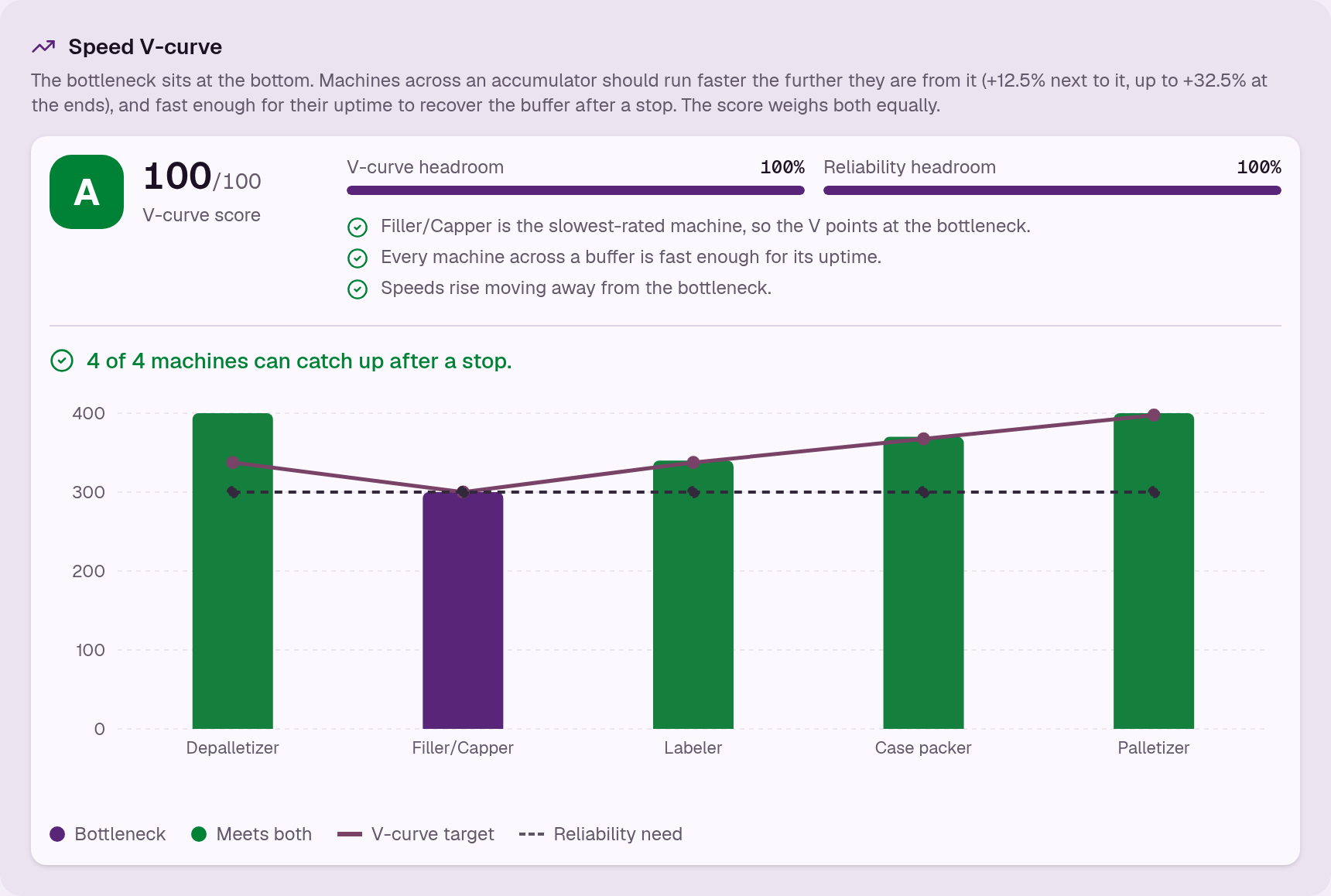
Chart those speeds as bars and you get a V, with the filler at the bottom.
The reason is recovery, and it works on both sides of the filler.
- Downstream, when the labeler stops, product piles up on the accumulator after the filler. When the labeler restarts, it has to run faster than the filler to work that pile off before the next stop. If it can only match the filler, the backlog never clears and the buffer protects you exactly once.
- Upstream, when the depalletizer stops, the filler keeps running off the accumulator in front of it. When the depalletizer restarts, it has to run faster than the filler to refill that accumulator, so the filler never runs out of product.
One catch: the V only pays off where there's accumulation between machines. Two machines locked together with no buffer start and stop as one. The filler and capper in the table are a good example: they're one monobloc, so a faster capper would gain nothing. Extra speed only helps a machine that has a buffer to recover.
What the beta does with it
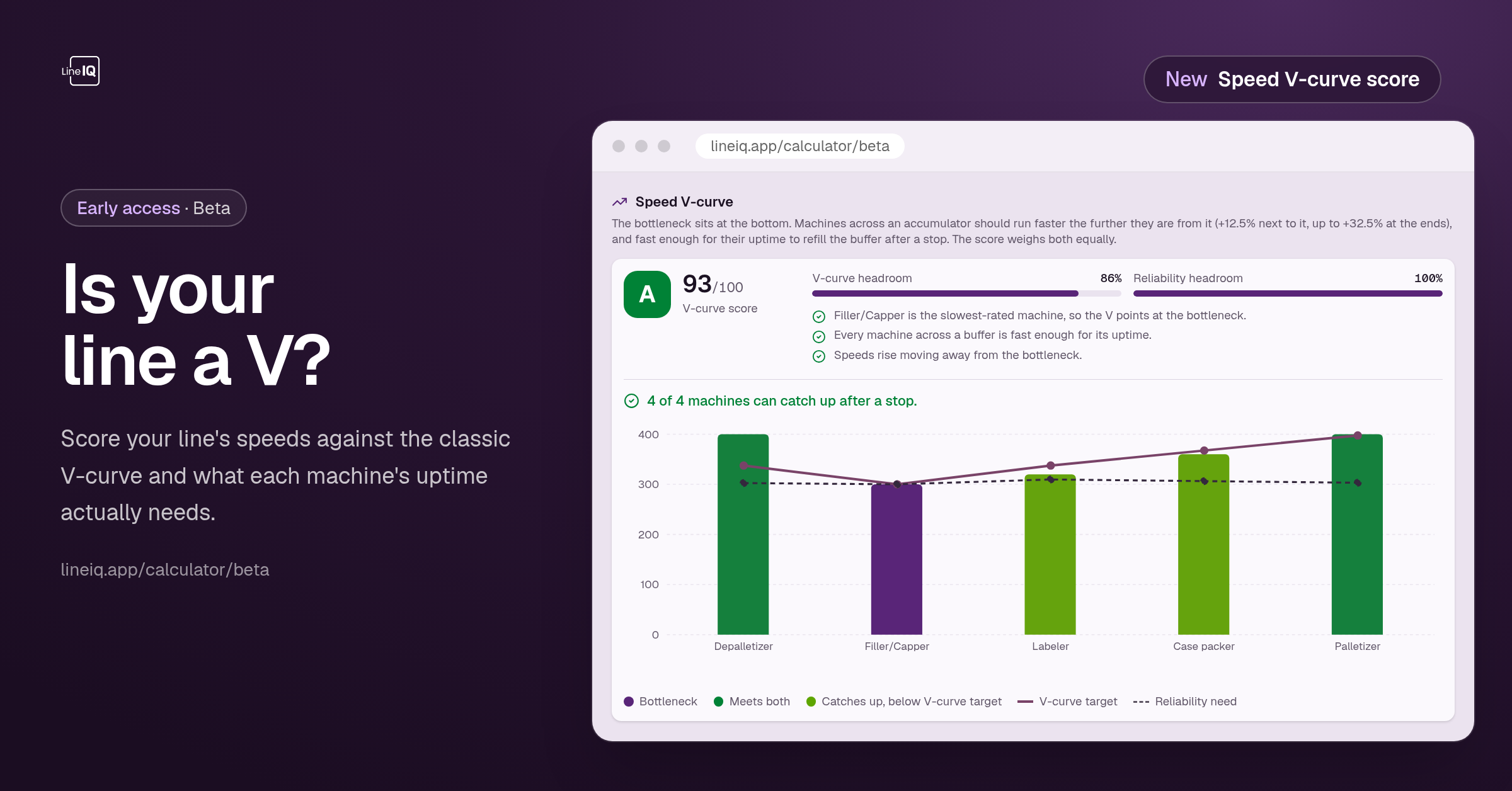
Open the beta calculator, enter your machines and accumulators, and the Line balance card shows a Speed V-curve chart:
- Bars for each machine's rated speed, with the bottleneck at the bottom of the V.
- A solid line for our V-curve target: +12.5% next to the bottleneck, rising to +32.5% at the ends of the line. When a machine is both next to the bottleneck and at the end, like the depalletizer above, the next-to-bottleneck target wins. Its 400 ppm comfortably clears that.
- A dashed line for what each machine actually needs, based on its uptime. A machine that stops often needs more headroom than the rule of thumb. A very reliable one needs less.
One note on "bottleneck." The calculator doesn't assume it's the filler. It finds the bottleneck from each machine's speed and uptime, the same way the rest of LineIQ does. It's usually the filler, but not always, and that difference matters for the score.
Then it grades the line.
How the V-curve score works
Every machine with an accumulator between it and the bottleneck gets checked against both lines, and the two count equally:
- V-curve headroom: how much of the extra speed its target calls for (above the bottleneck's speed) it actually has.
- Reliability headroom: how much of the extra speed its uptime calls for it actually has.
The line score is the average, out of 100, with three rules on top:
- -10 points for every machine that's slower than its neighbor on the bottleneck side. That's a dip in the V, and it becomes a second bottleneck when the line tries to recover.
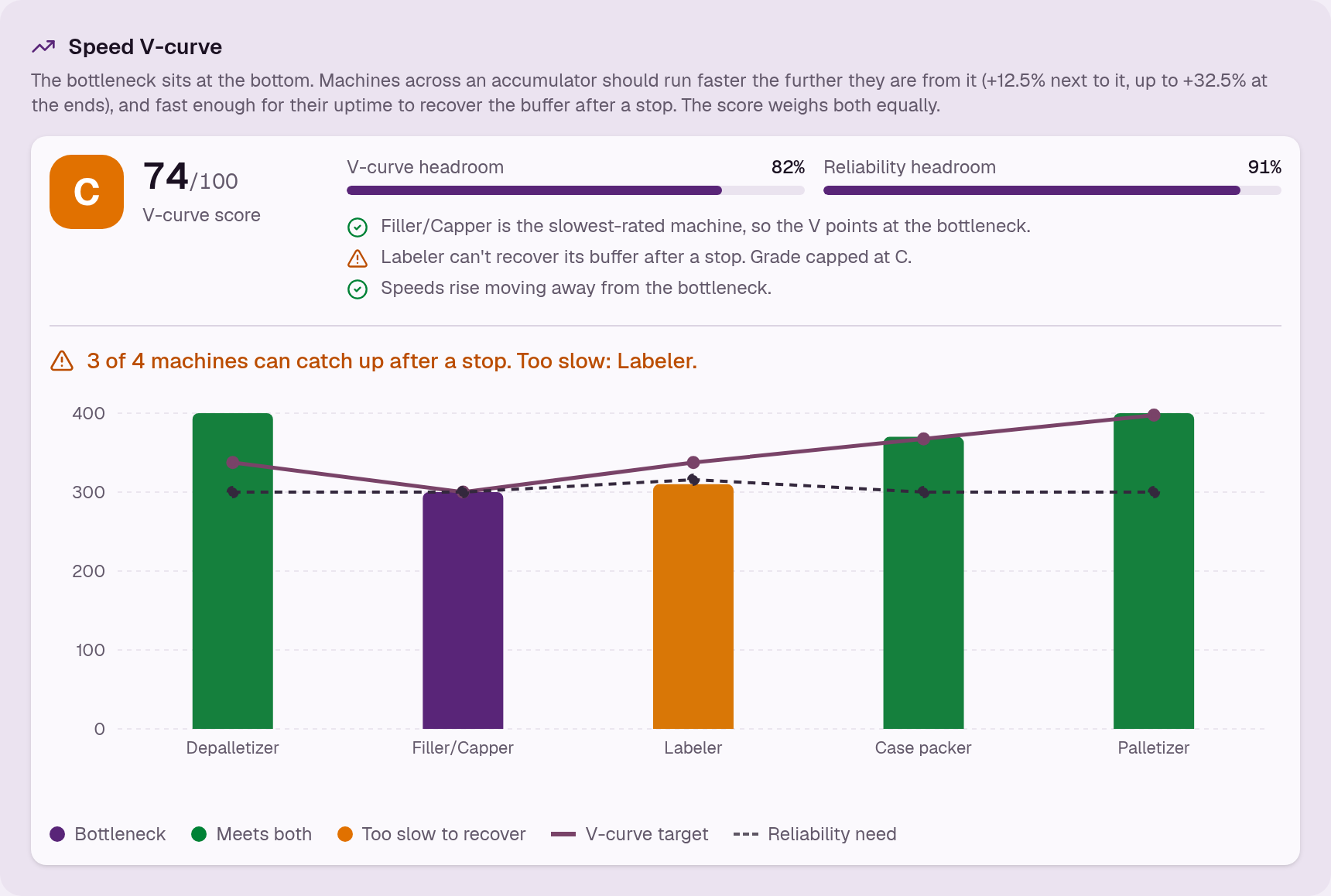
- Capped at 74, a C, if any machine can't recover its buffer after a stop.
- Capped at 50 if the bottleneck isn't the slowest-rated machine. That means the V is pointing at the wrong machine, usually because poor uptime has turned a faster machine into the real constraint.
Grades run A (90+), B (75+), C (60+), and D.
The example line above scores 100, an A. Now slow the labeler to 310 ppm and give it four 6-minute stops a shift, while the filler has two of its own. The same line drops to 74, the cap for a line that can't recover its buffer. The labeler only gains 10 ppm on the filler, so it can't work the backlog off before it stops again.
Why it's a beta feature
The V-curve is decades-old rule-of-thumb engineering, and every plant runs it a little differently. Most guidance puts the machine next to the filler 10–15% faster and the machines at the ends 25–40% faster. Some plants size from the filler out and some from the palletizer back. We use the midpoint of each range and space the machines in between evenly, then pair that with uptime math. We don't think we've got it perfect.
So it's in the beta: it's usable now, it's free to try, and the people using it get to shape what it becomes. The other beta features are in there too:
- Accumulator buffer time: enter how many minutes each accumulator actually holds, instead of treating every buffer as perfect.
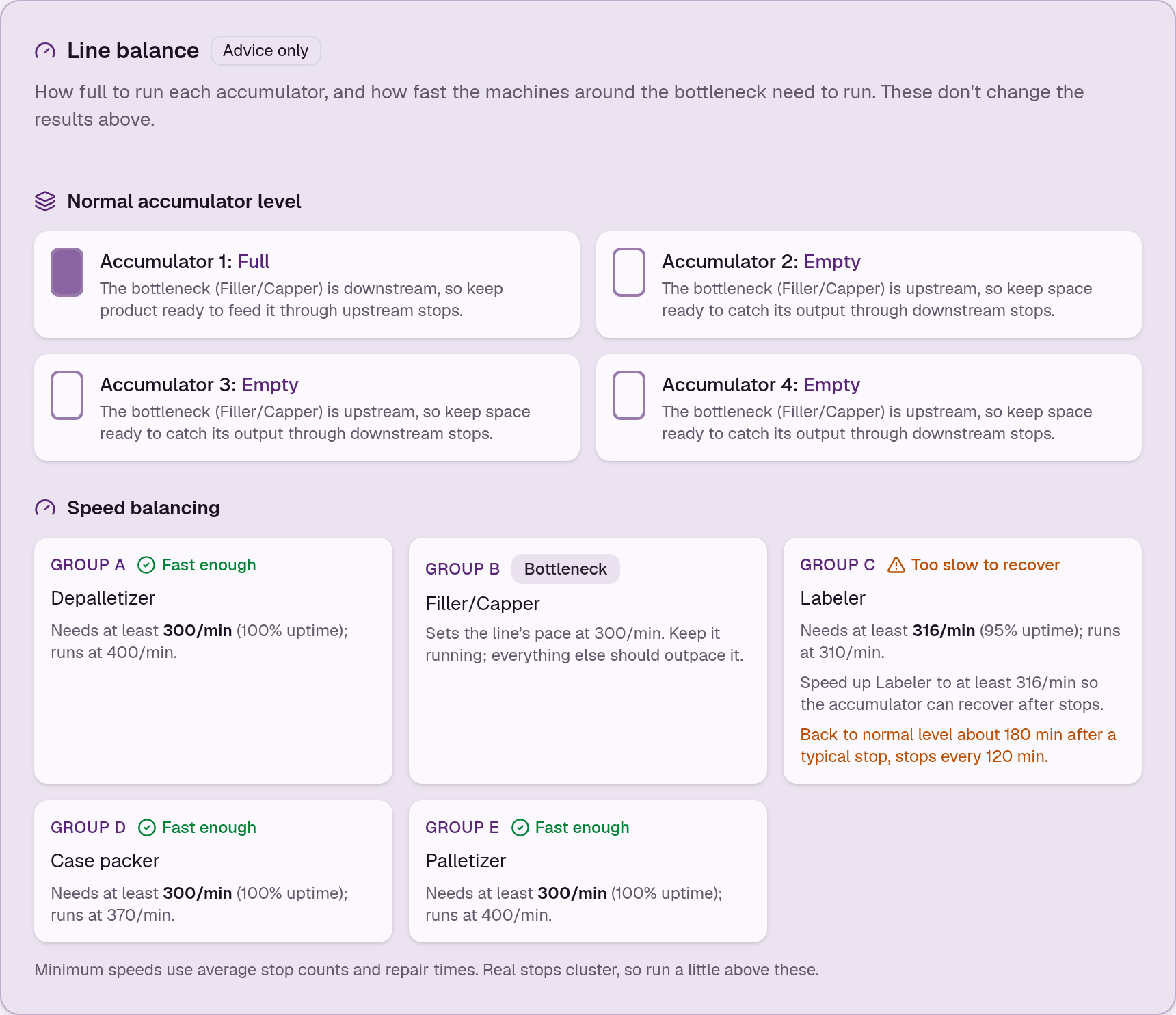
- Line balance advice: whether each accumulator should normally run full or empty to protect the bottleneck, and the minimum speeds needed to recover.
- Improvement options: model replacing a manual station, or switching a cartoner from tuck to glue, alongside your equipment upgrades.
What we want to hear
Run your own line through it, then tell us:
- Does the grade match your gut? If a line you know is well balanced scores a C, or a line that fights you every shift gets an A, we want to know why.
- Are the targets right for your lines? Tell us if +12.5% next to the filler and +32.5% at the ends is too aggressive or too soft.
- What's confusing? Any label, number, or chart that made you stop and squint.
- What's missing? The thing you'd need before you'd show this to your boss.
Send beta feedback. It goes straight to us, and we read every one. The best ideas will end up in the standard calculator.
Beta features may change or contain errors, so double-check anything you take to a capital request. That's exactly why we want more eyes on them.