Upgrade the Machine or Add a Buffer? A Decision Framework
A faster bottleneck machine and an accumulator both add output, but in very different ways. We price both on the same line, and the cheaper option isn't the winner you'd expect.
LineIQ Team4 min read
Every packaging line eventually hits the same budget meeting. Output is short, and two proposals are on the table:
- Upgrade the bottleneck machine so it runs faster.
- Add an accumulator so the line stops less often.
Both add products per shift, but they work in different ways. To pick the right one, you need to know which kind of loss your line has.
The example line
Five machines in series, no buffers, one 8-hour shift (480 minutes):
| Machine | Rated speed | Stops/hour | Minutes per stop | Uptime |
|---|---|---|---|---|
| Depalletizer | 240/min | 0.5 | 2 | 98.3% |
| Filler/capper monobloc | 220/min | 1 | 3 | 95.0% |
| Labeler | 280/min | 4 | 2 | 86.7% |
| Case packer | 300/min | 1 | 2 | 96.7% |
| Palletizer | 320/min | 2 | 2 | 93.3% |
The filler and capper are one monobloc: a single machine with a single drive, so they share the same speed and stop together. That's also why nobody puts a buffer between them. You don't want open, filled containers waiting on a conveyor for a cap.
Uptime here is simple: 4 stops an hour for 2 minutes each is 64 minutes lost per shift, so the labeler runs 416 of 480 minutes, or 86.7%.
On a coupled line, uptimes multiply. That gives a line uptime of 73.0%. The monobloc is the slowest machine at 220/min, so the line produces:
- 160.7 products/min effective
- 77,135 products per shift
There are two separate problems here. The monobloc caps the speed, and the labeler causes most of the stops. Each proposal fixes one of them.
Option A: speed up the monobloc
A $150,000 upgrade takes the filler/capper from 220/min to 260/min. That's 18% faster, so you'd expect 18% more output.
You get 9%.
Once the monobloc hits 240/min, it's no longer the slowest machine. The depalletizer is. The constraint moves to a different machine, and the remaining 20/min of monobloc speed does nothing.
| Baseline | Option A | |
|---|---|---|
| Bottleneck | Monobloc, 220/min | Depalletizer, 240/min |
| Line uptime | 73.0% | 73.0% |
| Products per shift | 77,135 | 84,148 |
| Gain per shift | +7,013 |
At $0.04 profit per product and two shifts a day, that's $561 a day and a payback of 267 operating days.
The lesson: before you buy speed, check how far the next-slowest machine is behind the bottleneck. That gap is the most speed you can actually use.
Option B: buffer the labeler
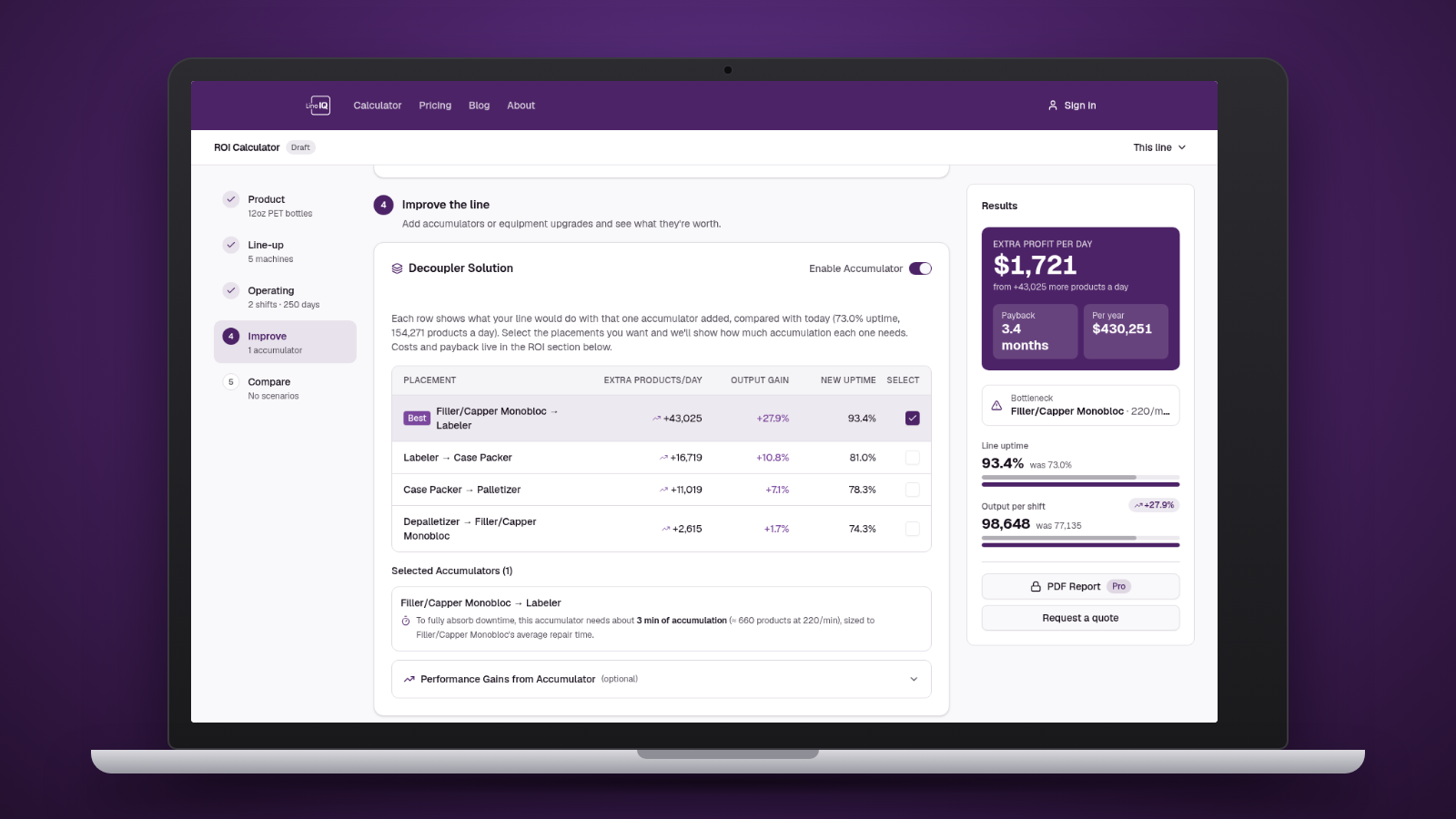
A $175,000 accumulator goes between the monobloc and the labeler, where the containers are already filled and capped. The labeler's frequent short stops no longer halt the monobloc, and monobloc hiccups no longer starve the labeler. The line splits into two halves that run independently:
| Machines | Rate | Uptime | Effective | |
|---|---|---|---|---|
| Upstream | Depalletizer, monobloc | 220/min | 93.4% | 205.5/min |
| Downstream | Labeler, case packer, palletizer | 280/min | 78.2% | 218.9/min |
The buffer needs to ride through the longest typical stop on either side, which here is the monobloc's 3 minutes. That's roughly 660 capped containers of accumulation.
With that in place, the line runs at the pace of the slower half: 205.5/min, or 98,648 products per shift.
That's +21,513 per shift, about three times what Option A delivers, because it recovers lost time rather than adding speed. It works out to $1,721 a day and a payback of 102 operating days.
The result
| Investment | Extra per day | Payback | |
|---|---|---|---|
| A: Monobloc upgrade | $150,000 | $561 | 267 days |
| B: Accumulator | $175,000 | $1,721 | 102 days |
| A + B together | $325,000 | $2,236 | 145 days |
The accumulator costs $25,000 more and pays back in well under half the time. Doing both pays back in 145 days, and the order matters. With the buffer in place, the faster monobloc lifts the upstream half to 224.2/min, but the downstream half now limits the line at 218.9/min. The upgrade adds only 6,443 products per shift on top of the buffer, so added second it pays back in 291 days instead of 267.
The framework
Five questions to ask before the budget meeting:
- What's the speed constraint? Find the slowest unit by rated speed. Machines running in parallel count as one unit with a combined rate, and so does a monobloc.
- Where is the time going? Rank machines by downtime minutes per shift, not by rated speed. The biggest loss is usually a different machine from the speed constraint.
- How much speed can you actually use? The gap between the bottleneck and the next-slowest machine is the most a speed upgrade can deliver.
- Is line uptime below about 85%? If so, losses are compounding across machines, and a buffer next to your worst machine usually beats speed. Above about 90%, speed is usually the better lever.
- Compare them in payback days, not percentages. Percent gains hide the price. Payback days put both options on the same scale.
And always check the combination. A buffer moves the constraint, which can make a later speed upgrade worth more or, as on this line, less.
Try it on your own line
The LineIQ calculator runs this comparison for you. Enter your machines, toggle an upgrade or an accumulator, and compare payback side by side, with a PDF you can take into that budget meeting.
Which would you have picked: the cheaper upgrade, or the buffer?